Wednesday, 24 October 2012

Audience viewing figures (secondary audience)

Inbetweener’s: Series 3

The First Episode shown on 13 th September had 2.2 Million viewers, from channel 4.
10% of that was on E4 at 10 o’clock till half 10.
2.9% was from viewers watching on E4+.
Therefore having more platforms of channels to show the programme on , increased the viewing figures by a lot.

The final episode of series 3 got the highest amount of viewing figures the programme had ever got before, getting a massive 2.62 million views from channel 4.
12.9 % from 10 o’clock till half 10 on E4.
3.3% (342,000 views) on E4+.
Prior to its launch, the slot average for that year had been 347,000 views (1.7%).
Managing to beat all other multichannel competition in the slot, beating BBC2, Channel4, and Channel5 which were all in the million mark at this point.

Reference : www.guardian.co.uk/media/2010/sep/14/inbetweeners-e4-tv-ratings


Fresh meat

The opening episode of Fresh meat series 2 aired on the 28th September 2012 got 1.69 million viewers.
However the second episode on the 5th on October, the viewing figures dropped to 1.2 million , but when being shown on E4+ the figures raised to 1.37 million. Which shows by showing your programme on one then one channel boosts the viewing figure. Here are a couple more viewing figures I found on BARB from Fresh meats series 2.

14th October – 1.49 million viewings
21st October- 1.43 million viewings
28th October – 1.24 million viewings figures


For the first series of Fresh meat the average viewing figures were 2.7 million. Therefore through my research it shows that the viewing figures have fallen massively over the series, showing the audience are losing interest in the sitcom.


Mighty Boosh;

Mighty boosh had an average of 1 million viewings for the 3rd series.

I.T crowd:
IT crowd had an average of 2.5 million viewers for there 4th series.


Therefore I have created a graph displaying all 4 Programmes average viewing figures:  


Summary

This shows that the most popular programmes are the inbetweener’s and IT crowd. I Believe this is to do with the target audience as inbetweeners is shown on E4 , their target audience being 15-35, and this programme is about teenagers , and the target audience watching is many teenagers , therefore its important what channel you show your programme on and the target audience who watch then channel , having a big impact on your viewing figures.This is something to think about when creating our own programme, and also this that it must fit with the E4 target audience age. As all for these concepts affects the viewing figures. 


Wednesday, 17 October 2012

Narrative

Inbetweeners- Episode 1 series 3:


Tzvetan Todorov


Equilibrium: 
The program starts with an introduction to the character will , and his everyday life as he walks through school, and then goes to a clip of the 4 characters in a car on the way to sixth form , resembling every day life.

Disruption:
There is a fashion show being held for charity , however there is not enough models for the show. Will does not agree with the concept of a fashion show.

Recognition:
Will is asked by the head master Mr Gilbert's to take part in the fashion show , will refuses to , therefore creating a conflict as the head master makes will take part. Will and the other characters are also asked to take part in modeling in the show , simon is asked , however jay is not, even though he would like too. He is then asked to model with charlotte. simon models however has a wardrobe malfunction.  

Attempt to repair:
Will agrees to take part in the fashion show by collecting money , to resolve the conflict. He also  models with charlotte he does this to impress the character of charlotte in which he loves.

New/Return Equilibrium:
goes back to everyday life , as the four boys go home together, with a voice over of will suming up the days events.


Vladimir Propp

Will: Hero


Jay: The helper


Simon: The helper


Neal: The helper


Mr Gilbert: The Villain


Carly: The helper


Alistair : False Hero


Charlotte: Princess 


Roland Barthes

Action:
The narrative flow of the episode flows like any other sic-com , where a problem arises , and is resolved by the end of the episode. The fact it is set in a school represents the target audience watching , teenagers around the same age. The fact it is set in a school also gives it a light-hearted feel the the program.

Enigma:
The enigma is the mystery be hide the story , in see case its how will the fashion show event unfold , leavning the audienece waiting. Also you could say , will the protgonist "will" ever get the girl "charlotte". which links to every episode leaving the audience waiting to see if they ever actually get together.

Semic:
The code refers to connation within the story , the connation and denotation of the characters to be seen through their costume , such as the use of stereotypes to portray the characters e.g. the character of will , through the use of costume and voice. They have used the stereotypes to connote to the audience the character of will , as he is a geek , by using his costume his allows anyone to notice that , involving all types of audience.


Symbolic:  This is similar to the semic code , however on a deeper meaning scale, such as ...

 Cultural: The culture code is the sterotypes of the genre , e.g. will in a sic-com there is also a character who comes up with ideas to get out of trouble or is the more geeky character. Also sic-com alwy follow the same narrative flow , which allows the audience to know that it is a sic-com, also to give them an indication to what the programme storyline may be , and how it will resovle. As the audience have a knowledge of this as it is part of most sic-coms or programes.

Tuesday, 16 October 2012

What legislations and regulations cover the internet?


Legislations:

Internet laws are similar to the law of broadcasting, retail and information handling. All institutions need to ensure that IT facilities re provided in accordance with relevant legislations and that the users are aware of their legal rights.
The law covers lots of things, some of the laws are:
  • Copyright data protection
  • Data protection
  • Computer misuse

For example the copyright law covers copyright violations such as, software piracy. The law stops people from stealing the author/producers work.


Regulations:

Internet regulation is basically restricting or controlling access to certain aspects of information.
The regulations consist of:
  • censorship of data
  • controlling aspects such as domain registration
  • IP address

Regulations for the internet:

instructions about the structure, conduct or content of the media.
Examples include media ownership, also limits on the amount of advertising on television, or an operating or receiving license for television or radio.

Monday, 15 October 2012

Narrative terms

Narrative

Tzvetan Todorov - Russian theorist

Todorov is pretty much the structure in which the story follows.
Its split into 5 parts:

1)      Equilibrium: This is the normal state at the beginning of the text. E.g. every normal day life.

2)      Disruption of the Equilibrium: This is when an action or conflict is introduced into the narrative. E.g. a bad event has taken place.

3)      Recognition of Disruption: Action or conflict noticed by protagonist. E.g. The Hero watches or hears of the bad event.

4)      Attempt to repair: This often brings change to the character. E.g. Hero tries to save the day.

5)      New/Return Equilibrium: The conflict is resolved nd the narrative strands are tied together. E.g. The hero saves the day , an everything goes back to normal life.


Vidimir Propp:

He was a Russian critic who examined 100 German fairytales. By doing this he came up with 8 character roles.

1)      The Villain – e.g. The fairy god mother

2)      The Hero – e.g. Shrek

3)      The Donor – e.g. puss in boots

4)      The helper - Donkey

5)      The princess – Fiona

6)      Princesses father-  Fiona’s father

7)      The Dispatcher – Donkey

8)      The false Hero – The fairy godmothers son


Roland Barthes

Roland came up with 5 codes which identifies 5 narrative codes, which the reader uses to decode text, which creates meaning to the audience. Codes:

1) Action: Is a series of events which link it to a genre, e.g. a gun connotes the film is violet and action packed, or a rose connotes it’s a romantic film or rom-com , which builds up the expectations of the film. E.g. in the opening of mission impossible the bad guy ‘antagonist’ is holding a gun , connoting the film will be violet. 

2) Enigma: The enigma is the mystery be hide the narrative , e.g. mission impossible starts at the end and the ‘ antagonist’ is talking to the ‘protagonist’ and as an audience we want to find out the answer which will be revealed later in the film. So it gives  sense of Spence and mystery to the viewer.   

3) Semic: This code refers to connotation within the story which gives a deeper meaning to the basic denotation meaning. E.g. in the opening scene of mission impossible the setting it dark and gloomy, therefore the deeper meaning and connotation of this is to portray the dark, dangerous atmosphere which the characters are facing.

4) Symbolic: This is similar to the semic code, but works on a wider  e.g. in mission impossible they use the stereotype of a male as the villain and a male as the hero , and then a female and the heroin , suggesting women are more venerable and need saving.

5) Cultural: The cultural code is the stereotypes of the genre e.g. in mission impossible guns are involved which straight away allows the audience to know the more is  a action movie , which straight away tells them the plotline of the story as ll action movies follow the same sort  of story line. As the audience have a knowledge of the film. 

Thursday, 4 October 2012

Anaylsis of Inbetweener's website page


For own coursework we are to create a short video clip. We have chosen to do fiction production. For own programme we have to create a fan webpage which consists of 3 pages. Therefore I have chosen to analysis E4's fan page for the inbetweener’s, as it is also a sit-com. I will focus on the semiotics of the webpage, and the effects created by them.


The anchorage is the title ' The inbetweeners' which connotes they don’t fit in well with other people , they are the outcast group this tells the audience a little bit about what the programme will involve. The syntagms of this page is a very clear, straight layout, making it easy to the audience to view. It is a very topical website layout, with the navigation bar at the top. The navigation bars are in the topical colour of the E4 website itself. The colour of the website relates to the production company which shows the programme, not the actual programme inbetweeners.  The syntgam of the photo is placed t the top of the page, the photo of which is very big , the effect of this is to attract the audience. The Paradigmatic are included within the picture of the four boys, showing the stereotypes within the programme. The four boys are wearing costumes which relate to their stereotype, of which is meant to be very geeky silly school boys. The character of will stands out from the rest of the boys , as he is dressed very smart in  black suit and tie. He also has a very serious face which could connote to the audience he is the sensible one in the group, and tends to keep the boys from getting into trouble. The character of jay , stood on his right is a very scruffy looking boy and is wearing just  white shirt , with very messy hair, by placing him next to will who is dressed very smart , it connote just how messy his character is. On the left on will is Simon. Simons facial expressions are very serious and moody, witch connotes to the audience he is maybe the kill joy of the group and doesn’t like getting into trouble. At the back of them all is Neil; he is a very tall and dopy character. His facial expressions are a big cheesy grin, which tells the audience a little about his character and maybe suggests he is the loud out-going character, but is also a little less smart and is the character that brings humour to the programme. Wills character is a little bit separated from the rest of the characters which also adds to the idea of his personality being a little different to the rest. I like how they have used this picture, as it allows the audience to learn more about the characters and their relationship, simply through a photo, this is something I will think about when creating my webpage. They have used lots of great things such as the picture and colours to attract the audience to the website, making them want to look through it, and attract them to the actual programme itself.


The image displayed on this section is will and a female character leaning again him. The denotation of this picture is just simply a picture of a boy and girl. However the connotation is displayed through their body language, such as his tense smile and stanza, which tells the audience he is very, uncomfortable which tells the audience he gets nervous around girls. The website allows you to write comments about the show, allowing the audience to feel part of the show.
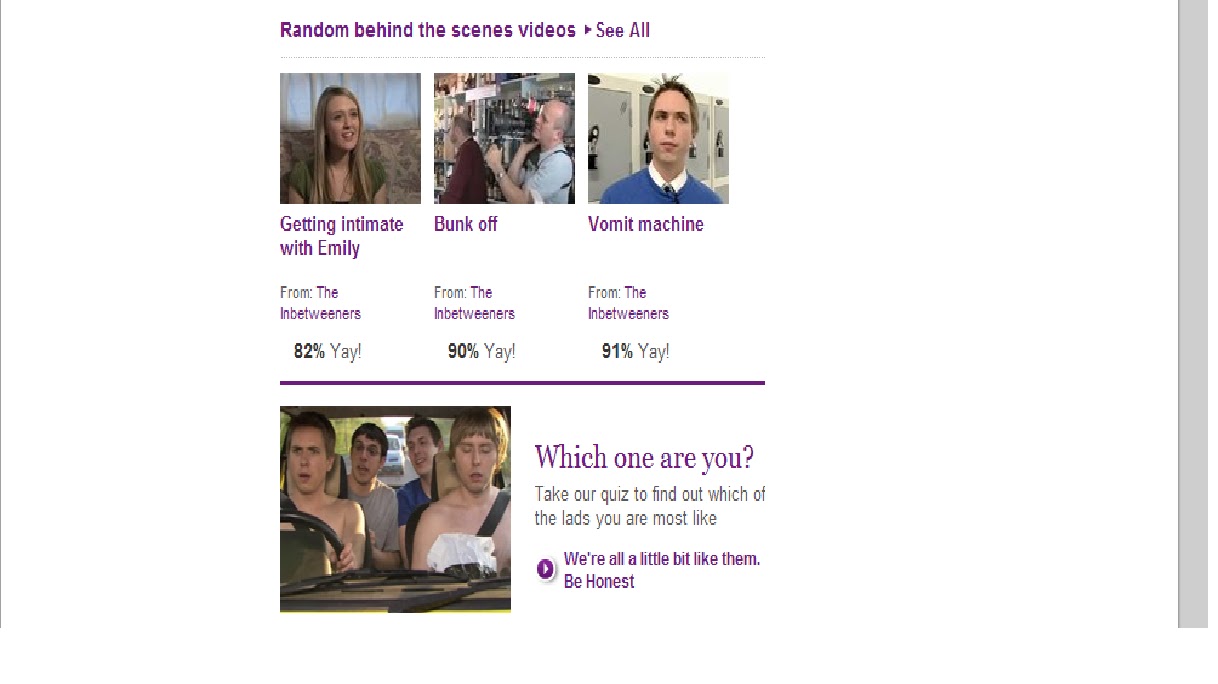
The side bar allows the viewers to find out more about the character, and take part in quiz’s, and watch episodes they may have missed. The layout is very plain and simple, which allow all members to view the page and understand how to use it. The structure of the website is very good using syntagms and paradigms effectively.


The website is very well anchored in text, for every section of writing there is a bold, purple heading which informs the audience what the text below involves. This is important as it makes it easier for the audience to understand the information they are supplying. There is also text under every image conveying what each image is about, allowing the audience to know the purpose of each image. Such as above there are 3 images 2 of characters and one of the filming of the show, above the images is text which informs the audience they can click the pictures and watch be hide the scene clips , however without the text the reader may have just thought they were random images placed on the screen. 

Questions to consider.

From my analysis of inbetweeners , i have came up with these questions to help me create my own programme:

  • Who are my target audience?
  • What time will my programme been shown at, and how will this effect my target audience?
  • Where will my locations been when filming?
  • What locations will i use to create a certain atmosphere and meaning to the audience?
  • Who will my cast consist of, and how will this effect the meaning of my programme?
  • What camera angles and shots will work best?
  • How will i attract my audience?
  • What lighting will i use to create certain moods?
  • What sterotypes will i include, and how will i protray them to the audience?
  • What will be the name of my programme and what meaning will this create to the audience?
  • What will be the purpose of my programme?
  • What costumes will the characters wear?
  • How will the costumes influence the audiences impression of the character?
  • What age will the characters be,and how will it represent them as a age group?
  • How will the programme relate to the audiences everyday life?